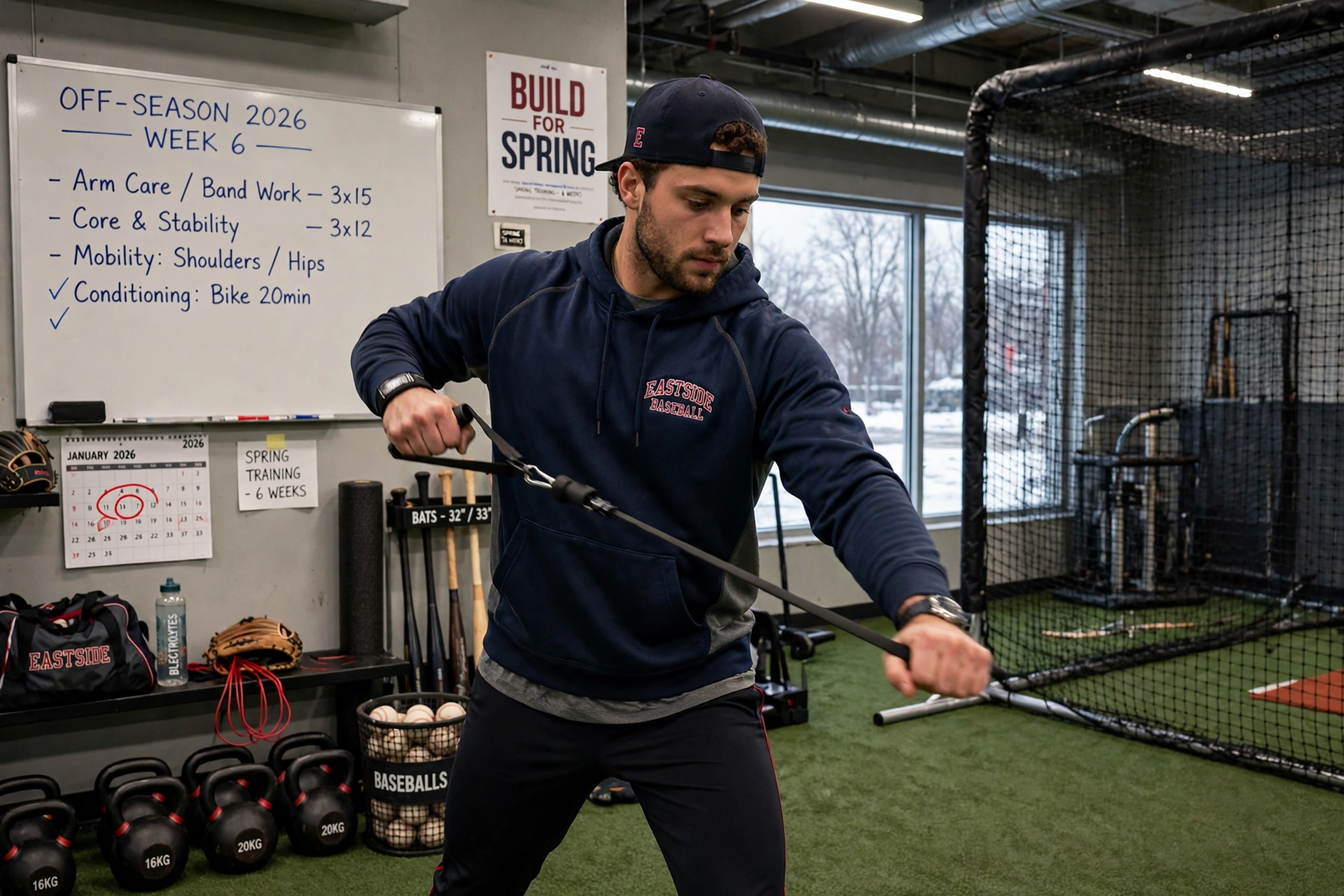
Every fall, the same worry shows up in travel baseball households. The season ends, the bag goes in the garage, and a parent starts wondering whether some other 13-year-old is already in a cage somewhere, taking 300 swings a night and throwing bullpens in December. The natural response is to sign up for more.
The problem is that more baseball in winter does not reliably produce a better player in spring. The players who peak in April, May and June are usually the ones whose families treated the offseason as a plan with phases, not as a fourth season.
Why "More Baseball" Feels Right but Often Backfires
The logic sounds airtight. If baseball skill comes from baseball reps, then more reps in winter should mean more skill in spring. But throwing and swinging place repeated stress on the same tissues, and young athletes need time away from that stress to recover and to build the general strength that makes baseball skills hold up.
The research on young pitchers points the same way. In a study of adolescent pitchers published in the American Journal of Sports Medicine, players who had needed shoulder or elbow surgery had pitched more months per year, more games, and more pitches than healthy pitchers, and had more often pitched while their arms were tired. The authors found that the factors most strongly tied to injury were overuse and fatigue, with showcase participation also linked to higher risk.
The concern is not limited to pitchers. A study of more than 1,000 young athletes in the same journal found that specializing in one sport was an independent risk factor for injury. Athletes who spent more hours per week in organized sports than their age in years had higher odds of a serious overuse injury, as did those whose ratio of organized sports to free play was greater than two to one.
We have written before about why year-round pitching is still the fastest path to burnout and injury and about the dangers of over-specialization in youth baseball. This article is about the practical side: what a smarter winter actually looks like on the calendar.
What the Guidelines Actually Say
Families do not have to guess. MLB and USA Baseball publish Pitch Smart guidelines for ages 13 to 14 that call for no more than 100 combined innings pitched in any 12-month period and at least four months off from throwing every year, with at least two to three of those months in a row. The same guidelines advise against playing for multiple teams at the same time, against catching on days a player is not pitching, and in favor of playing other sports during the year.
The American Academy of Pediatrics, in its clinical report on sports specialization and intensive training, recommends that young athletes take at least one to two days off per week from their main sport and at least three total months off during the year, in blocks of about one month. The report also says playing multiple sports, at least until puberty, lowers the chances of injury, stress and burnout.
None of that says "stop training in winter." It says stop doing the same thing all year.
Periodization in Plain Language
Periodization is a coaching word for planning training in phases, where each phase has a different job.
For a 12U to 15U player who wants to be at their best from April through June, a four to six month offseason might look like this.
Phase 1, roughly October through mid-December: Recover and play. No overhead throwing. This is where the continuous two to three month break that Pitch Smart describes usually fits best. Play basketball, soccer, wrestling, swimming or anything else the player enjoys.
Phase 2, roughly December through January: Build the athlete. Introduce or continue a supervised strength program two or three days a week, with a focus on squats, hinges, lunges, pushing, pulling, core control, jumping and sprinting. The National Strength and Conditioning Association's position statement on youth resistance training states that a properly designed and supervised program is relatively safe for youth and can improve strength, power and resistance to sports injuries. The 2014 international consensus statement on the same subject reached a similar conclusion, with the condition that qualified professionals design and supervise the program.
Phase 3, roughly mid-December through February: Return to throwing gradually. Start with short, easy catch sessions and build distance and intensity over several weeks. Hitting sessions should be short and aimed at one or two mechanical fixes rather than hundreds of swings.
Phase 4, roughly March: Ramp toward competition. Increase throwing intensity, add live at-bats and bullpens with sensible pitch counts, and keep strength work going at a lower volume so the player stays strong into the season.
Families should count the four months off from throwing across the whole year, not just the winter. If the winter break covers two to three months, plan where the rest will come from, such as a planned break after the summer season.
A Sample Mid-Winter Week
Here is one example of what a January week could look like for a 13-year-old in Phase 2 moving into Phase 3. It is a starting point to discuss with your player's coaches and, if there is any history of arm pain, with a sports medicine professional.
Monday: Supervised full-body strength session, about 45 to 60 minutes.
Tuesday: Another sport or free play. No baseball.
Wednesday: Light catch progression and a short hitting session focused on one mechanical goal, about 45 minutes total.
Thursday: Supervised strength and speed session, including sprints and jumps.
Friday: Off.
Saturday: Another sport, or a skill session with fielding footwork and light throwing.
Sunday: Off.
Two things matter about this week. It includes at least two days with no baseball, which matches the AAP's guidance, and, counting the other sports too, the total hours of organized activity should stay under the player's age in years, the threshold linked to higher overuse injury risk in the study of more than 1,000 athletes.
Warning Signs That Winter Is Too Much
Watch for arm soreness that lasts into the next day, a player who stops wanting to go, poor sleep, and velocity or bat speed that drops as spring approaches. The surgery study mentioned above found that injured pitchers had more often pitched with arm pain and fatigue, so treat pain as a signal to stop and get it checked, not something to push through. For more on that, see our guide to protecting a young player's arm.
Questions to Ask Before Signing Up for a Winter Program
How many throwing days per week does the program include, and when does throwing start?
Who designs and supervises the strength work, and what are their qualifications?
Does the program build in days off and allow players to play other sports?
How does it track total workload if a player is also on another team?
Our earlier piece on what travel baseball players should be doing in the fall and winter covers the mental and skill side of the offseason, and our look at when to double down on travel ball and when to diversify can help with the bigger scheduling picture.
At CurveballCritiques.com we believe that the best offseason is a planned one. Families deserve clear, evidence-based information about how winter training choices affect spring performance and long-term health, so they can ask better questions of the programs they pay for and give their players a real chance to peak when it counts.