Every travel organization says it develops players. But development is not a slogan. It is a set of daily choices about how practice is built, how feedback is given, and how much attention each kid actually gets.
We have already written about the difference between coaching to win and coaching to develop on game day: lineups, pitcher usage, and playing time. This article goes one level deeper, into the practice field, where most real development happens or quietly fails to happen. Parents can use it to evaluate a team, and coaches can use it as a checklist.
Why the Scoreboard Is a Poor Measure of Development
A team can win at 10U or 12U with a few early-maturing kids and a short pitching rotation while the rest of the roster stands still.
USA Baseball's Long Term Athlete Development Plan, released with support from Major League Baseball, was built partly because of problems its own audit identified in the amateur game, including a lack of coaching education, early single sport specialization, year-round play, and what it called "the disproportionate ratio between development and competition." The plan's recreational track recommends that players ages 7 to 12 spend about 75 percent of their time practicing and 25 percent competing, and that players 12 to 16 spend about 65 percent practicing and 35 percent competing, according to the published plan.
Compare that to a calendar with three tournaments a month and one practice a week.
Drill Design: Lines and Reps vs Game-Like Practice
What a win-focused practice often looks like
Twelve kids stand in a line at shortstop while a coach hits ground balls one at a time. Each player gets a handful of reps and spends most of the time waiting. Batting practice is the same pitch, at the same speed, in the same location. It looks organized, and players look good doing it.
What a development-focused practice looks like
Players are split into small stations so nobody stands around for long. Ground balls come at different speeds and angles, and the fielder has to make a throw to a target or a base. In the cage, pitch type and location are mixed, so hitters have to read and adjust instead of grooving one swing.
In a study published in Perceptual and Motor Skills, Hall, Domingues and Cavazos (1994) gave collegiate baseball players extra batting practice twice a week for six weeks. One group saw fastballs, curveballs, and change-ups in random order. Another group saw them in blocks of the same pitch. On a random-pitch test afterward, the random group improved 56.7 percent from their pretest, the blocked group 24.8 percent, and a group with no extra practice 6.2 percent.
A practice that looks a little messy, with more variety and more mistakes, may be teaching more than one that looks clean.
Feedback Quality: Noise vs Useful Information
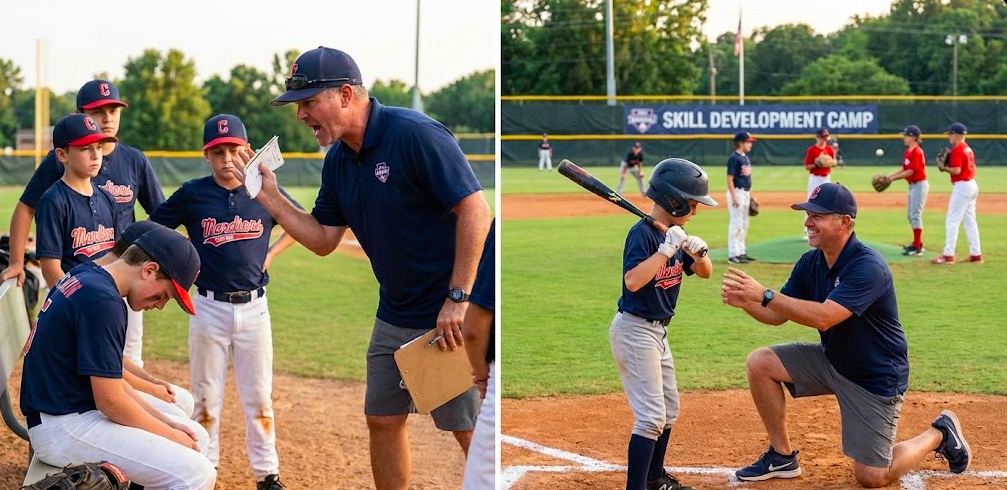
Win-focused feedback
The loudest feedback on many travel teams is about outcomes, like "You have to make that play." Or it is a list of body corrections shouted all at once: elbow up, stay back, head down, load earlier. The player hears a lot and learns little.
Development-focused feedback
Good coaches give fewer cues and make them specific. They often point a player's attention at the result they want, such as "drive the ball through the middle" or "throw to the chest of the first baseman," rather than at a body part.
That approach lines up with a large body of research. In a review of 15 years of studies, motor learning researcher Gabriele Wulf found that instructions or feedback directing attention to the effect of a movement (an external focus) consistently improved performance and learning compared to instructions about body movements (an internal focus). The benefits showed up across different tasks, skill levels, and age groups, including children.
Questions a parent can ask: After a mistake, does the coach explain what to change, or only that it was wrong? Does your child come home able to repeat one or two clear things they are working on?
Individual Attention: The Top Three vs the Whole Roster
On win-focused teams, attention follows talent. The best pitcher gets the bullpen sessions and the top hitters get the extra cage time. Kids at the bottom of the depth chart get fewer reps and less instruction.
Development-focused coaches give every player a plan, such as two or three written goals, a quick check-in during warm-ups, or a rotation for extra time. The USA Baseball plan describes the 14 to 16 stage as one where training should become increasingly individualized, which is hard to do if a coach only knows the strengths and weaknesses of three kids.
Project Play at the Aspen Institute and the Utah State University Families in Sport Lab surveyed parents in 2019 and reported that the average child quits a sport by age 11, most often because it stops being fun. When parents rated where their child felt pressure in sports, coaches scored highest.
Off-Field Habits: What Players Learn Between Games
Development is not just mechanics. Good coaches teach habits that carry forward:
How to warm up properly and why it matters.
How to recognize arm fatigue.
How to prepare for an at-bat by watching the pitcher.
How to reset after a bad inning.
How to talk to a coach without a parent doing it for them.
Arm care is the clearest example. MLB and USA Baseball's Pitch Smart guidelines recommend that 13 and 14 year olds set and follow pitch count limits and required rest, avoid playing for multiple teams at the same time, and take at least four months off from throwing every year, with at least two to three of those months in a row. The general Pitch Smart guidance also says every league, travel team, showcase, and tournament should set rules so players follow those limits. A development-focused coach teaches these rules. A win-focused coach often treats them as an obstacle. For more, see our guide to protecting a young player's arm.
Long-Term Outcomes: What to Look For Over a Season
Look at a full season and ask:
Is my child measurably better at two or three specific skills than in the first month?
Has my child played more than one position, especially at younger ages?
Does my child understand why the team practices the way it does?
Does my child still want to go to practice?
Did the coach follow pitch count and rest rules every time, including in elimination games?
If most answers are yes, you have found a coach who develops players, even if the trophy shelf is thin. If most answers are no, a winning record is covering for a lack of real coaching. Our list of coach red flags to watch at tryouts and in the first three weeks can help you spot the warning signs earlier, and these questions to ask before committing to a travel team are worth bringing to your next tryout.
A Note for Coaches
None of this requires a bigger budget, just planning. Write down the goal of each station, shorten lines, mix pitch types in the cage, pick one cue per player per day, and follow pitch count rules every time.
At CurveballCritiques.com we believe that the best travel coaches are judged by how much better their players get, not by how many trophies the team brings home. Families deserve honest information about which programs actually teach the game, and coaches who do this work well deserve recognition. Use these questions when you evaluate a team, and share what you learn with other families.